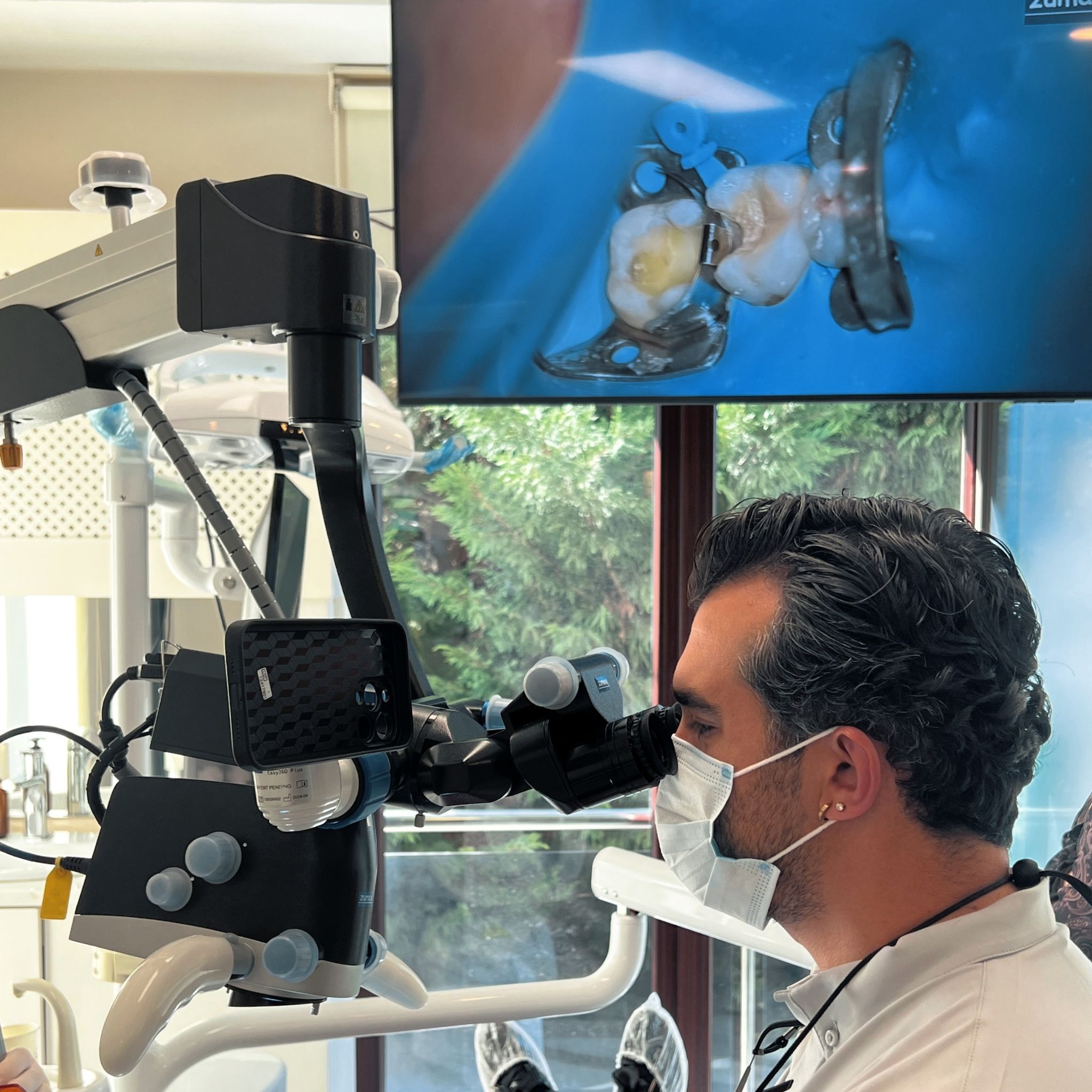
Microscope-Assisted & Biomimetic Dentistry
Seeing the detail, preserving the natural.
In modern dentistry, success is measured not only by whether the treatment is carried out, but by how precisely it is planned and how much it respects the tooth structure. Today, the goal is to achieve maximum protection with as little intervention as possible and to keep the natural tooth structure healthy in the mouth for many years.
At Dentist Taha Yasin Sarıkaya’s clinic, treatments are planned with microscope-assisted imaging systems and a biomimetic dentistry approach. This allows details that are hard to see with the naked eye to be evaluated more clearly, while aiming to prevent unnecessary loss of tooth structure.
The goal: not to imitate the tooth, but to preserve the natural tooth as much as possible.
Microscope-Assisted Dentistry
Managing what the eye cannot see
In dentistry, some details are too small to be noticed with the naked eye. Microcracks, details inside the root canal, early-stage problems or restoration margins can directly affect the success of treatment. Microscope-assisted dentistry adds a high level of precision to the treatment process by allowing these details to be seen much more clearly.
Dental microscopes provide high magnification and powerful illumination during dental treatments, allowing the working area to be examined in detail. As a result, the diagnosis, planning and treatment processes proceed in a more controlled way.
Main advantages of the microscope-assisted approach:
- Opportunity for earlier diagnosis
- More precise treatment planning
- A more controlled procedure
- Preservation of healthy tooth structure
- A clearer field of view during treatment
- More predictable results
The better you see, the more accurately you treat.
Why Do We Use a Microscope?
The use of a microscope is of great importance, especially in dental treatments where detail determines success. Being able to clearly see even the smallest structures of the tooth helps the dentist work in a more conservative and controlled manner.
Microscope assistance is an important factor that improves treatment quality, particularly in root canal treatments, aesthetic restorations, crack detection and minimally invasive procedures. This is because some problems can be managed with smaller interventions when they are detected early.
Microscope assistance provides important advantages in the following areas:
- Detecting microcracks
- Locating canal openings and details during root canal treatment
- Evaluating old fillings and restoration margins
- Working with millimetric precision in aesthetic procedures
- Removing decayed tissue in a more controlled way
- Preserving healthy tooth structure
- Detailed checking of fit after treatment
Detail determines the outcome.
Advantages of Microscope-Assisted Treatments
Microscope-assisted dentistry allows treatment to be carried out more precisely and in a more controlled way. The aim of this approach is not only to solve the problem, but to preserve the natural structure to the highest possible degree without causing unnecessary damage to the tooth.
A clearer field of view helps the dentist work more safely in smaller areas. This way, tissue loss during treatment can be reduced, procedural precision can be increased and a more comfortable process can be achieved.
Main advantages:
- Maximum precision
- Minimal tissue loss
- A less traumatic procedure
- More controlled treatment
- Clearer diagnosis and application
- Preservation of healthy tissue
- Aiming for longer-lasting restorations
- Improved patient comfort
We work with a “less intervention, better results” philosophy.
Biomimetic Dentistry
Not imitating nature, but understanding it
Biomimetic dentistry is a modern approach that aims to preserve the natural structure, function and biological properties of the tooth. The main goal of this philosophy is to preserve the tooth in its natural state as much as possible and to plan any necessary restorations in harmony with the tooth’s own structure.
While some conventional approaches may require more extensive tissue removal, the biomimetic approach avoids unnecessary loss of tooth structure. In this way, the strength, function and natural structure of the tooth are preserved as much as possible.
Objectives of the biomimetic approach:
- Avoiding unnecessary tissue loss
- Applying minimally invasive techniques
- Preserving natural tooth structure
- Supporting the function of the tooth
- Planning the restoration in harmony with the tooth
- Aiming for long-term success
The best restoration is a natural tooth preserved as much as possible.
Core Principles of Biomimetic Dentistry
Biomimetic dentistry is not merely an aesthetic approach. It is a holistic treatment philosophy that takes into account the tooth’s structure, flexibility, behaviour under forces and chewing function.
In this approach, every procedure is planned with respect for the natural architecture of the tooth. Only as much intervention as necessary is performed, as much healthy tissue as possible is preserved, and restorations are designed to be in harmony with the tooth’s natural structure.
Core principles:
- Minimum intervention
- Maximum preservation
- Supporting the natural structure
- Treatment that respects tooth tissue
- Preservation of function
- Aesthetic and biological harmony
- Aiming for long-lasting results
- Reducing the need for retreatment
This philosophy focuses on preserving long-term dental health rather than offering a short-term solution.
Why Is the Biomimetic Approach Important?
Teeth are not just an aesthetic feature; they are important biological structures for chewing, speech, facial support and overall oral health. For this reason, dental treatments should consider not only appearance, but also the function and long-term health of the tooth.
Thanks to the biomimetic approach, the natural tissues of the tooth are preserved as much as possible. This can help both extend the life of the tooth and reduce the potential need for more extensive treatments in the future.
Key contributions of the biomimetic approach:
- Helps preserve the lifespan of the tooth
- Aims to reduce the need for retreatment
- Helps achieve more natural results
- Respects the biological structure of the tooth
- Helps prevent excessive tissue loss
- Supports long-term oral health
It is a treatment philosophy that plans for the long term, not just for today.
Combining the Microscope and the Biomimetic Approach
Modern dentistry is not about doing more; it is about doing the right thing, at the right time and with the right precision. When microscope-assisted imaging and the biomimetic approach are used together, treatments can be planned in a more controlled, conservative and predictable way.
The microscope gives the dentist the ability to see detail. The biomimetic approach, in turn, aims to preserve the natural tooth based on those details. This way, results that are more balanced aesthetically, functionally and biologically are targeted.
Together, these two approaches provide the following advantages:
- Clearer diagnosis
- More precise treatment
- Less tissue loss
- Preservation of natural tooth structure
- A more comfortable process
- Aiming for long-lasting treatment
- Planning aesthetics and function together
At Dentist Taha Yasin Sarıkaya’s clinic, the microscope and biomimetic dentistry approaches are evaluated together to achieve more precise, more natural and longer-lasting results.
Book an Appointment for Microscope-Assisted Treatment